Artificial intelligence appears on the scene, first and foremost, as a voracious user of existing energy and a competitor with all other uses for electrical infrastructure: power plants, transmission lines, transformers, and so forth. As such, it is a vector of cost inflation aimed at the heart of the American household, which lives in a home built for, adapted to, and reliant upon reliable, cheap electrical power. If, as seems likely, the boom in data centers outruns the growth of electrical supply, the only way to meet the demand will be to raise the price of electricity to all other users. This will deepen inequalities and increase the precarity of life for American householders, who cannot easily adjust their electrical consumption. In simplest terms, AI emerges as a competitor for the juice of life.
A second risk is that the AI boom will come to an end thanks to radical over-investment and over-production of a good (or is it a service?) for which there is insufficient economic use. This result would resemble the Internet crash of 2000, a shakeout that deflated the NASDAQ and drove a great many young and once-promising startups to the wall. But the Internet survived, and the associated infrastructure, though overbuilt at first, was eventually absorbed into the fabric of economic life. The recession of 2000 was not the Great Depression.
As artificial intelligence continues to develop, then one must ask, for what does it substitute? The answer is not far to seek: artificial intelligence is a cheap substitute for the real thing. Human intelligence is something that is cultivated slowly, at great expense, over time. It requires vast investment in fixed capital with limited alternative uses: schools, universities, libraries, training grounds, and more. In the neoliberal era, the predominant rationale for maintaining these institutions has been their contribution to the future earnings of the inmates, and their role in maintaining something called the “competitiveness” of the country. Both are undermined by AI. Perhaps the school and the university can be returned to their older roles as a form of luxury consumption good, in demand for their own sake in a society liberated from the pressures of routine mental labor. Perhaps, but it’s not likely – the more likely outcome is that these institutions will shrink, and many will disappear.
There is yet another possibility. It is a possibility that comes closer to the 1929 scenario and to its consequences for the Depression. Suppose that something were to emerge that, all of a sudden, undercut the expected profitability of the entire AI sector, rendering the massive investment in data centers as stranded assets, like the steel mills of Youngstown or (still earlier) the textile mills of Lowell and Lawrence? And suppose, further, that that were something that emerged from outside the United States, so that it did not presage a later era of growth and prosperity in line with the new paradigm?
That possibility exists. There are hints of it already. They come, of course, from the People’s Republic of China. Should it happen – and it could – that the Chinese outplay the Americans in the AI race – then everything that is solid (and well, nothing is) would turn to dust. Watch for it.
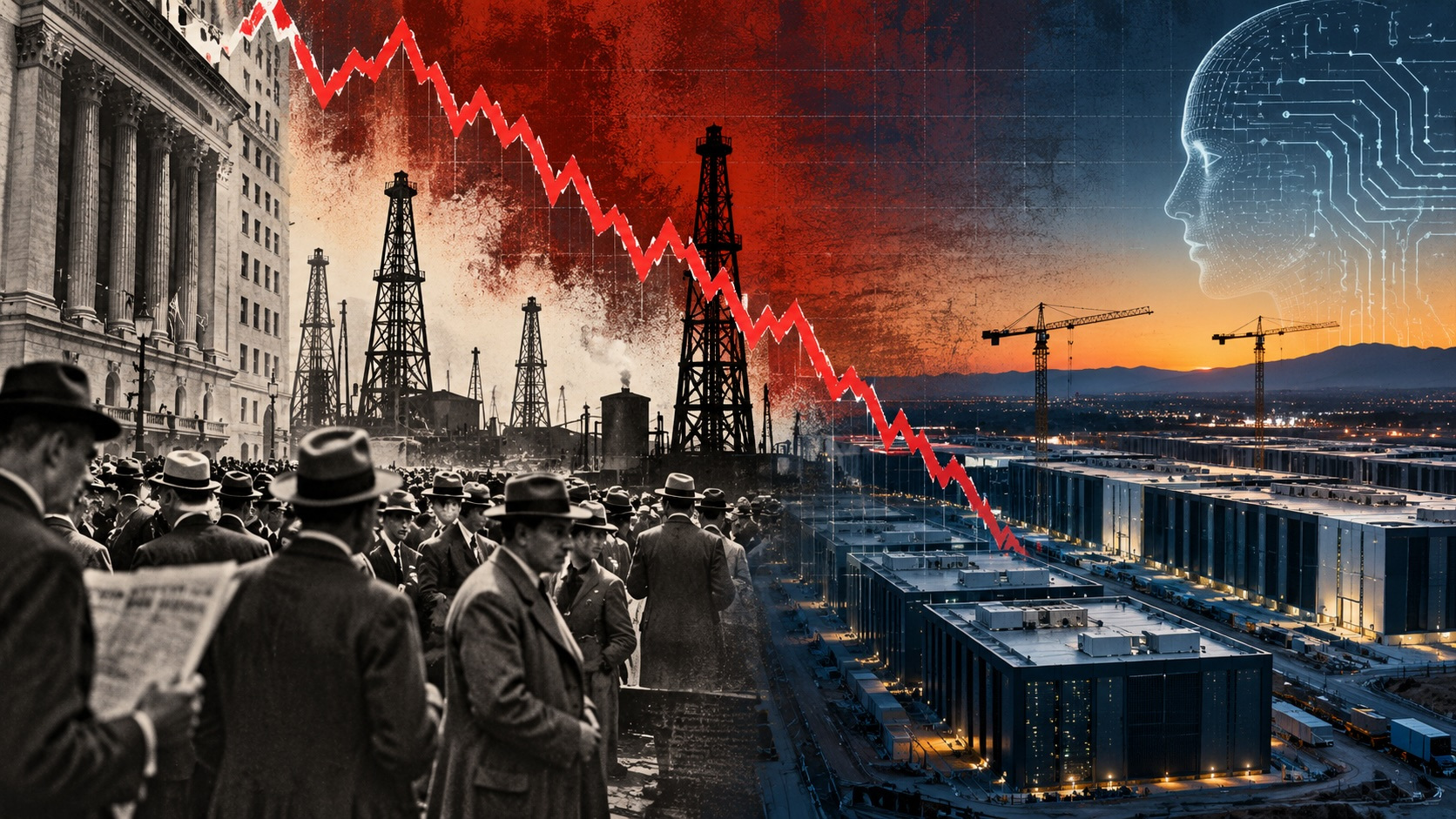
The collapse of oil prices and the collapse of stocks, 1929
人工知能は、まず第一に、既存エネルギーを貪欲に利用し、電力インフラ(発電所、送電線、変圧器など)における他のすべての利用と競合する存在として、登場します。したがって、これは、信頼できる安価な電力に合わせ、かつそれに依存して建てられた住宅に住むアメリカの家庭の核心を狙ったコストインフレのベクトルです。もし、予想通り、データセンターのブームが電力供給の増加に先を走るのであれば、需要に応える唯一の方法は、他のすべての利用者に対して電力料金を引き上げることです。これは、電力消費を容易に調整できないアメリカの世帯にとって、不平等を深め、生活の不安定さを増大させます。最も簡単に言えば、AIは生命のジュースに対する競争相手として現れます。
第二のリスクは、AIブームが、根本的な過剰投資と商品(あるいはサービス)の過剰生産により終わることです。経済的利用が不十分であるこの結果は、2000年のインターネット崩壊に似ており、NASDAQを下落させ、多くの若くかつて有望とされたスタートアップを壁まで追い込みました。しかし、インターネットは存続し、付随するインフラは当初は過剰に建設されていましたが、最終的には経済生活の構造に吸収されました。2000年の不況は大恐慌ではありませんでした。
人工知能が発展し続ける中で、何に取って代わるのかと問わざるを得ません。答えは遠くありません:人工知能は本物の安価な代替手段です。人間の知性は、時間をかけて、大きな代償を払ってゆっくりと育まれるものです。それは、固定資本への大規模な投資と、代替利用が限られる(学校、大学、図書館、研修施設など)を必要とします。新自由主義時代において、これらの制度を維持する主要な根拠は、受刑者の将来の収入への貢献と、国の「競争力」と呼ばれるものを維持する上での役割であった。どちらもAIによって弱体化しています。おそらく、学校や大学は、日常的な精神的労働の圧力から解放された社会において、自己のために需要が高まる、贅沢な消費財という旧来の役割に戻ることができるかもしれません。可能性はありますが、可能性は低いです。むしろ、これらの機関が縮小し、多くが消滅する可能性が高い結果となります。
別の可能性があります。それは、1929年のシナリオに近く、そしてそれが大恐慌にもたらす結果に近い可能性があります。たとえば、何かが突然、AIセクター全体の予想収益性を下し、データセンターへの大規模投資が取り残された資産として浮上したとしたら、ヤングスタウンの製鉄所や、(さらに以前の)ロウェルとローレンスの繊維工場のように?さらに、それが米国外から生じたものであり、新たなパラダイムに沿った後の成長と繁栄の時代を予見しないと仮定すると、
その可能性は存在します。すでにそれの兆候があります。もちろん、彼らは中華人民共和国から来ています。もし起こり得ること、そして起こり得ることとして、AI競争において中国が米国を上回ることになると、確固たるもの(そして、何も堅実でないもの)はすべて塵になるでしょう。ご注意ください。
原油価格の崩壊と株式の崩壊、1929年
What Can the Last Great Crash Say About the Next One? Oil, AI, and the Perils of Technological Revolution
https://www.ineteconomics.org/perspectives/blog/what-can-the-last-great-crash-say-about-the-next-one-oil-ai-and-the-perils-of-technological-revolutionArticle
What Can the Last Great Crash Say About the Next One? Oil, AI, and the Perils of Technological Revolution
97 Years After Black Tuesday, Are Investors Making the Same Mistake?
It is an odd fact that 100 years after the Great Crash of 1929 and the ensuing Great Depression, no satisfactory and certainly no agreed explanation for these events has been arrived at.
My father’s book, largely written from newspaper accounts at Dartmouth in the summer of 1954, was the first history focused on the Crash. Up until then, the turbulence of the Depression, the New Deal and the war had absorbed scholarly, popular and political attention, and the drama of October, 1929 was beginning to fade in memory. The Great Crash 1929 assured that it would not.
By placing the Crash front-and-center, my father could tell a fine tale of financial folly, replete with chicane and rooted in the almost-innocent all-American desire to get rich without really working. It is a motif with many antecedents and also many recurrences. The elements of exuberance, hubris and comeuppance – just or not – tie financial markets to the larger human experience. And this humanizing approach has been followed by others who have since tackled the theme; Charles Morris and Andrew Ross Sorkin notably come to mind.
To the extent that a theory has been built around the Crash, it is Hyman Minsky’s “Financial Instability Hypothesis.” The story is of phase transitions in the structure of debts – hedge, speculative, Ponzi – similar to the transition of water from ice to liquid to steam as temperature rises. Stability breeds instability, Minsky wrote, and episodes like the Crash are endemic to capitalism; the dynamism and the fragility are inseparable parts of the same beast. Benoit Mandelbrot’s “multifractal generator” of financial prices conveys the same message. The system generally delivers gains, but the same process can, with utter unpredictability and no warning, deliver a colossal blow that takes them all away.
A second relevant – though highly inconvenient and therefore, studiously neglected – concept is William K. Black’s “control fraud,” defined as (what else?) fraud committed by those in control. Control fraud is collapse by design, or bankruptcy for profit as George Akerlof and Paul Romer described it. The canonical case was the Savings and Loan debacle of the 1980s and 1990s, when deregulation facilitated the criminal takeover of major institutions, notably in California and Texas, protected for too long by their political friends. For those watching closely, the detection of control fraud can make collapses predictable in certain situations, such as those leading up to the Great Financial Crisis of 2007-2009. This is why the Big Short, chronicled by Michael Lewis, could occur.
These narratives and their associated theories focus attention on financial processes and financial markets. Such processes and markets have, in this construction of the nature of things, a life of their own. They are detached from something called the “real economy” and can, it seems, be analyzed without reference to specific legal systems, cultures or technologies. The approach universalizes financial instability, so that any one such episode becomes more-or-less comparable with any other, going back to the Dutch tulip craze of the late 17th century and forward to the current moment with artificial intelligence and data centers.
The comparability of financial debacles is captured, but not explained, by the physical metaphor of the bubble. That metaphor conveys, in a single image, both the steady inflation and the abrupt collapse – a certain denouement at an unknown time. Yet the metaphor substitutes for thought; it obscures the fact that there is no cause-and-effect explanation for either one. And there is no method for distinguishing a bubble from something else, amenable to that other deceptive metaphor, the “soft landing.”
The Crash and the Depression
What then is the relationship of financial instability to the so-called “real economy”? In particular, how did the Great Crash relate to the Great Depression?
The Depression is not the central focus of The Great Crash 1929, and my father gave only a cursory survey of five inter-related causes. These were a bad income distribution, a bad corporate structure (meaning too much leverage), a bad banking structure (meaning no deposit insurance), a “dubious foreign balance” (meaning vulnerability to debt default), and the “poor state of economic intelligence,” meaning the pre-Keynesian commitment to balanced budgets. The implication, one supposes, is that if these matters had been dealt with during the 1920s, the Depression might not have occurred. But then, the 1920s would not have been the 1920s. I would not lean too heavily on such a view, and I don’t think my father would have either. The fact is, he didn’t feel it necessary to explain the Depression in this short and focused book – and so far as I know, he didn’t do it elsewhere.
My father did believe that the Crash helped to kick off the Depression; otherwise he might not have written his book. But on this point, mainstream economists have disagreed. For the dominant school of modern economics, the Crash could not have “caused” the Depression or even influenced it. For this school, the market economy is inherently stable or self-stabilizing, and the financial markets are only indicators of the underlying drift. To affect the “real economy,” something must hit the real economy, as it were, from the outside. Some kind of “shock” is necessary. Some economists have also argued that the slump was underway before the Crash, so that the stock market becomes an incidental effect, rather than a cause, for the dark years that followed.
A Brief Survey of the Chattering Economists
The mystery of the Crash and the Depression has given rise, over a century, to many mutually inconsistent views [1].
John Maynard Keynes, writing in 1930, argued that the very distinction between “financial” and “real” was untenable, misleading and beside the point. The collapse in the stock market was a collapse in profit expectations – a profound change in the social psychological foundation of business capital investment. Without expectation of profit, business investment also collapsed, and without the flow of investment, so did the aggregate demand for output. Thus Keynes could argue that the remedy was to increase effective aggregate demand by whatever means might be available, notably public expenditure and public works. This was the essence of Keynesianism: you don’t need to reverse the cause to effect the cure. But Keynes gave no very specific reason for the collapse in profit expectations, and his latter day followers (notably, George Akerlof and Robert Shiller) throw up their hands and repeat his reference to “animal spirits [2].” But is capitalism really subject to massive collapse on no precipitating grounds at all? And if so, why was the Great Crash such a rare, indeed practically unique event?
Milton Friedman and Anna Schwartz, writing in the early 1960s, blamed the Federal Reserve for not preventing the collapse of the money supply, and by extension the collapse of the money supply for the Depression. This interesting argument disconnected the crash from the Depression, and supposed (without establishing) that the power to prevent a crash of the money supply rested with the Federal Reserve in the first place. But it flowed from Friedman and Schwartz’s prior belief in the natural stability of the private economy, and therefore by construction the responsibility of government for any failures that might have occurred.
Charles Kindleberger, writing in 1973, stressed the weakness of the international monetary system, in the process of transition away from the hegemony of sterling but having not yet arrived at the hegemony of the dollar. Barry Eichengreen follows in and largely develops this tradition.
Peter Temin, writing in 1976, sought to critique Friedman and Schwartz, by then the dominant view among academic economists. Temin followed Keynes in stressing demand, but with the modification that he rooted the drop in demand in a shift of the consumption function, ostensibly exogenous and not itself easily explained. Did something happen to the American household in the late 1920s, not seen before or replicated since?
Jude Wanniski, writing in the mid-1970s, blamed the Smoot-Hawley tariff, an argument with a bit of support in The Great Crash 1929, which note that the tariffs helped precipitate Peruvian debt defaults, which helped undermine confidence in the banks that had made those loans. But this was not Wanniski’s mechanism; for him the essential offense was the sacrilege against free markets and free trade.
Ben Bernanke, writing in 1983, blamed a rise in “uncertainty,” and this argument was largely recapitulated by Christina Romer in 1988. Their argument linked the Depression to the Crash, but left the crash unexplained, as either an exogenous shock or something endemic to the financial markets. Bernanke focused on investment spending, while Romer added the dimension of consumer durables purchases. She writes that “the stock market crash caused consumers and producers to become uncertain about the course of future income.” (emphasis added).
I need not comment on some of the more recent work, dating to the 2000s, that blames the Depression on the New Deal, including on the price-fixing efforts of the National Industrial Recovery Act and the crop reduction programs of the Agricultural Adjustment Administration. This work conveniently places responsibility for events in 1929, 1930, and 1931 on policies enacted in 1933, a true feat of rational foresight. Indeed it has become somewhat fashionable to argue that the New Deal was entirely counterproductive, inhibiting the natural recuperation that would otherwise have occurred [3].
Meanwhile, for acolytes of the “real business cycle,” the Depression was normal, not anomalous, and therefore not an event that justifies the concern with which it has come to be viewed. Cycles happen thanks to the ebb and flow of technologies. Applied to this instance, the doctrine specifies that “total factor productivity” fell, and the rest followed. Yet total factor productivity is a vague notion, and no specific asset or specific technology appears to be associated with this idea. This led even so dedicated a “new classical” as Robert Lucas to remark in 1994, “What technological or psychological events could have induced such behavior in a large, diversified economy? How could such events have gone unremarked at the time, and remain invisible in hindsight?” A very sensible question.
In short, what a mess! Though some of it is plainly nonsense, the above list is not entirely wrong. It includes proximate causes, contributing factors, spurious correlations, and also empty, irrefutable assertions based on unobservables, such as Larry Summers’ 1986 remark that “What happened was a failure of the exchange mechanism.” What there isn’t, is a clear-cut precipitating event, that might explain both why the stock market crashed when it did and why capital investment collapsed, why the banks collapsed, and why demand and finally production also collapsed. It seems we have a better view of the extinction of the dinosaurs, the fall of Rome and the collapse of the Maya than our economists have given us of the defining economic events of the last century.
But suppose there was a precipitating event? Suppose we just missed it, because we did not understand the underlying economic processes that could turn such an event into a disaster?
Basics of Entropy Economics
All life requires resources, which must be extracted from the environment, with a sufficient surplus so as to make it possible to work, develop, grow and reproduce. And this is no less true of any mechanical system, or of any economy. Access to resources requires energy, which comes in the first instance from sunlight, or from its stored forms, including wood, coal, oil, natural gas – as well as the nuclei of certain very heavy atoms. To get at the energy requires tools, which are built according to plans, and at increasing levels of complexity as technologies advance. But complexity is a two-edged sword. It permits ever-greater efficiency in the use of resources, thus ever-greater levels of production and the improvement in human life – but it induces fragility in the system as a whole. Once a system is built, it functions in a certain, predictable and predetermined way, so long as the conditions for which it was designed hold good. But those conditions may change. Simple systems are robust; complex ones are prone to major breakdowns and disasters.
Economic value arises because that which is necessary, or desired, is often scarce. And this is particularly true of goods or services that are newly created, imagined, or packaged in such a way as to appear to be new. Innovation is by definition recent, and by definition has a single originator. Innovation is usually achieved by introducing a new level of complexity, as well as other improvements of design or recombination of existing technical forms. During the window, however brief, when imitations are few, the originator enjoys a degree of market and monopoly power, enhancing the economic value associated with the scarcity of the innovation. This is the moment when fortunes can be made. And economic life is dominated by the search for fortune, arising from producing that which is new, better, or made more cheaply but just as well, than that which already exists.
These are the basic elements of what Jing Chen and I, in a small book published in 2025, have called “entropy economics.” Our goal was (and is) to bring economics into alignment with the understanding, now prevalent in every other field of human inquiry, of the second law of thermodynamics – the entropy law – which is the most fundamental law of nature. We believe that this is the key to understanding that there was, in fact, a precipitating technological event behind both the Great Crash and the Depression.
For mainstream (neoclassical) economics, technological change is a largely continuous process, with phases of acceleration and deceleration. It cannot make things worse. That is why mainstream economists are relentless techno-enthusiasts – they see the dynamism of capitalism as its principal justification, in the face of inequalities, environmental degradation, and the working population’s native suspicion of the capitalist class. Joseph Schumpeter, a conservative but definitely non-mainstream observer of the 1930s, took a much colder and more clear-eyed view, summed up in the phrase “creative destruction.” Schumpeter’s insight was that new technologies destroy older civilizations and ways of life, leading (he argued) to improvements for the survivors but not without severe costs for those invested in the previous systems and methods. Indeed for this reason peasant farmers and medieval guilds were by nature technologically conservative: they wanted to keep what they had and were not concerned about the great gains accruing later on to someone else. Schumpeter however, so far as I’m aware, did not specifically identify a new technology bridging the crucial moment in this story.
We believe that the precipitating event, in this instance, was the announcement of the discovery, in Texas, Oklahoma and California, of vast reserves of oil.
Oil and the American Energy Revolution
The Industrial Revolution, which began in Britain in the early 19thcentury, was a revolution based on coal, and on the application of coal to machinery powered by steam. Its first application was to pumps, increasing the efficiency and reducing the cost of extracting coal from the ground. It spread from there to metalworking, especially steel, and to the application of steel to transportation, through the railroads and then the ocean-going fleet, and (still later) to electrification. British power was coal power, as it remained well until the time of Margaret Thatcher and North Sea oil.
The United States followed the British path, though with greater reserves of wood and substantial water power as well, finding coal in Appalachia to power a rail system that by mid-19th century spanned the entire continent. By the first decades of the 20th century the railroads were the largest (and notoriously predatory) American industry, and their derivative demand supported the iron mines of Minnesota and the steel mills of the Great Lakes. When the Federal Reserve was created in 1913, two of its regional banks were located in Missouri (at St. Louis and Kansas City), reflecting the centrality of the rail network to both agriculture and industry in the American heartland.
By the second decade of the century, however, a new energy source was developing. Trucks are powered by oil, as are airplanes; both came into heavy use in the first world war, and as Thorstein Veblen observed, invention is the mother of necessity. In 1919 a colonel named Dwight Eisenhower set out to cross the continent with a motor convoy; it took 60 days to make a transit that could be done on the rails, by that time, in less than a week. A transcontinental highway was created (the Lincoln highway), though when my father drove it in 1930 to reach Berkeley from Cleveland, the road was unpaved from Lincoln, Nebraska to the California line.
The 1920s were boom years for the automobile industry, with production rising to 5,358,000 units by 1929, a figure, reported in The Great Crash 1929, that “compares very decently with the 5,700,000 new car registrations in the opulent year of 1953.” It was also a booming time for tractors, which were transforming American agriculture. Around one-third of American arable land in the late 19thcentury was used for forage, including heavily for horses that did most of the hard work in front of the plow. Tractors liberated that land, some for food crops, some for cattle. They also worked faster, and required fewer people. Agricultural productivity soared, outrunning the American ability to eat, and even to export. Any significant interruption in demand was likely not to end well.
Yet none of this necessarily had to end, least of all with a resounding crash, over a few days in October, 1929. Oil was available, but it was relatively scarce, and therefore expensive. Coal, steam, steel and the railroads enjoyed the efficiencies of a large, developed, complex infrastructure, around which American cities and factories had already been built. There were indeed also urban rail systems – the subways that still survive in New York, Boston and Chicago, but also streetcars that were allowing Los Angeles, San Francisco, Washington DC and other, relatively new and growing cities to expand. These ran on electrical cables that were powered by coal. There was good reason to expect this technological paradigm to endure – until, suddenly, there wasn’t.
The key to the mystery has been found by Christopher Kennedy of the University of Victoria, British Columbia – an industrial/ecological economist with a strong record of research into climate and similar issues [4]. It lies not in any new invention, but in discoveries that changed the valuation of oil and therefore the prospective profitability of everything that ran on some other fuel. This was the discovery, in the late months of 1929, of vast new reserves in Texas, Oklahoma and California [5].
Specifically, as Kennedy found, on October 22, 1929, The New York Times announced that Standard Oil of California was cutting the price of oil by 50 to 75 cents per barrel, about 50 percent, “due to big overproduction”, with other majors expected to follow. Stock losses for the 23d were reported at $4 billion. The next day was Black Thursday, “the first of the days which history, such as it is on the subject, identifies with the panic of 1929 [6].” Then, on October 29, alongside $14 billion in losses on the 28th (“another terrible day”), the Times reported that Standard Oil of New Jersey would cut the storage of oil: there was more, readily available, than could be sold. The same day came Black Tuesday, “the most devastating day in the history of the New York stock market, and it may have been the most devastating day in the history of markets.” The Great Crash of 1929 had occurred.
But how could such a massively favorable development, the discovery of an essentially unlimited, high quality source of energy for every conceivable industrial, agricultural and home use – not to mention military – lead to a panic in the financial markets and a collapse of real activity? This is not something that the mainstream view of technical change can hope to explain! By all rights, what was found across the American West in 1929 should have led to an economic boom – to an explosion of productivity, production and prosperity. But it did not. Or to be more precise about it, it did not do so at once, and did not promise to do so for the immediate or even medium term future.
On the contrary. The problem is that the stock market captures the expected future profitability, not of the economy in general, but of the existing economic system. In 1929, that system was centered on rail, steel, coal and steam, and on factories built to use the system of transport and marketing that had been built around the great railroad corridors that came to span the North American continent after the Civil War. Suddenly, the future of that existing system was not merely in doubt. It faced an abrupt and certain demise, as coal declined and oil took its place. With no profit expectations there would be no investment, and without investment total demand would fall – just the sequence described by Keynes.
Why not just convert the rails to oil? Because the writing was on the wall, not just for coal-fired locomotives but for the railroad economy as a whole. And you cannot build a new economy based on cars, trucks and airplanes without roads and airfields, and refineries and pipelines and gas stations and fuel depots. These, as yet, did not exist at scale. And in 1929 it was very far from obvious that they would come to exist in the foreseeable future. Indeed, who would provide them? It is hard (even now) to make roads pay with tolls. And as the markets and activities declined, so did tax revenues and, therefore, so would the resources available to units of government below the federal level. Nor would the federal government step up, so long as those who ran it believed themselves constrained by the revenues they might be able to collect from taxes.
The path from Crash to Depression runs through the crisis of the banking system. The banks held assets of two very large types. One was mortgages on farm land and crop loans. These would fail as farmers could not unload their rising production at a profit. The ensuing foreclosures would put farm land on the market, cutting into the collateral of those who remained and deepening their ruin. And the other large-scale asset, held by banks, was the debts of the railroads. These too could not be honored. Banks that could not collect on either industrial or agricultural loans were at risk, and their depositors, once alerted to this fact, would not stick around. Runs ensured a large-scale contraction of the banking system. Bank failures doubled from 1929 to 1930, rose again in 1931, and peaked in the early months of 1933. After that, Roosevelt took office, took action, and the crisis eased.
The New Deal is remembered, in the then-contemporary literature and by most of the historians [7], mainly by the great rush of legislation that began with the Hundred Days: the Emergency Banking Act, Agricultural Adjustment, the National Industrial Recovery Act, the Public Works and Works Progress Administrations, the Civilian Conservation Corps, the Tennesee Valley Authority. These were followed in the Second New Deal by the Wagner Act and Social Security, and – after three decades, in Lyndon Johnson’s Great Society, by Medicare and Medicaid. But there is more to it.
The Reconstruction Finance Corporation had been created under Herbert Hoover, with limited purposes. Roosevelt greatly expanded them, investing vast powers in Jesse H. Jones of Houston, Texas – a man who was intimately familiar with the rise of oil [8]. Jones set up the RFC in the regional branches of the Federal Reserve System and proceeded to fund waves of infrastructure investment relevant to oil: 600,000 miles of paved roads (paved mostly with asphalt), a thousand airfields, the Bay Bridge, Triborough Bridge, Lincoln Tunnel and more [9], including diesel-electric locomotives for the railroads [10] and an oil-fired aircraft carrier for the Navy. By the end of the 1930s the infrastructure was in place, the technological uncertainties had been resolved, and the path had been cleared toward the highways-and-suburbs economy that would flourish (for better or worse) from the 1950s to the 1970s.
An energy-entropy interpretation of the Great Crash, the Depression and the New Deal thus achieves what no other effort has been able to manage: it integrates all three events into a coherent whole, and ties the financial economy to the real economy. It is consistent with Keynes’s core insight – a collapse of profit expectations leading to a collapse of capital investment – but without the seeming randomness of a purely psychological collapse of “animal spirits.” It shows why the private economy could not recover on its own, refuting the monetarist view of Friedman and Schwartz, and equally today’s libertarians whose faith is in the self-stabilizing properties of private markets and reversion to trend of growth statistics. It shows precisely in what way the technical contribution of the New Deal was decisive in charting the path forward – whether one likes the oil-based economy that resulted is an entirely separate question. And it casts light on the crisis of the 1970s, when oil suddenly became scarce and expensive once again, and also on the recovery since 2009, when fracking restored the energy economy of the United States – for the time being.
Entropy Economics and the AI Boom: Lessons from the Great Crash
As the centennial of the Great Crash approaches, the United States is once again caught up in a boom, fueled by the artificial intelligence investments of the “magnificent seven” companies whose valuations now dominate the stock market. Many of the conditions identified by my father for the 1920s are readily recognizable: the bad income distribution, the bad corporate structure (leverage and concentrated power), a bad (highly concentrated) banking system, the dubious foreign balance – and, once again, a “poor state of economic intelligence.” By my father’s lights, we should be all set, give or take, for a repeat of the Crash and an ensuing Depression.
What, then, about precipitating factors? In particular, what about energy, and what about the specific properties and characteristics of artificial intelligence and data centers?
At present writing, the energy economy is fraught with geological, geopolitical and technological unknowns. For the United States, oil and natural gas have been abundant since 2009 – quite unexpectedly so. Thanks to the advent of fracking and the high productivity of the Permian Basin, the United States has become once again the world’s largest producer of petroleum and a major exporter of natural gas. How long this will last is a first unknown: the well count has been declining, and production may have peaked in 2025. The future of the price is a second unknown: in particular whether it will remain above the level required to encourage new exploration and more intensive drilling. The effect of such a price on every other form of economic activity in the country is a third unknown, though it is obvious that the American economy, writ large, runs on low oil prices.
What does not appear to be in the offing is the much-vaunted “energy transition” that will leave oil, gas and coal in the dustbins of economic history. It is true that substantial increments from wind and solar have been achieved, and a modest revival of nuclear power may be getting underway. But Jevons’ Law, now more than 150 years old, states that for every new source of energy brought on-line, new uses also appear, and the end result is that all forms of energy are used, in ever greater quantities. Jevons’ Law has not been repealed, and the world today uses more coal, oil, gas, hydro and nuclear power than it ever did before [11]. Periodically since the dawn of the atomic age, new forms of energy have been trumpeted as likely to undermine the fossil fuel economy in the same way that oil broke the back of coal after 1929. There is no obvious sign of any such thing in the near future.
Artificial intelligence appears on the scene, first and foremost, as a voracious user of existing energy and a competitor with all other uses for electrical infrastructure: power plants, transmission lines, transformers, and so forth. As such, it is a vector of cost inflation aimed at the heart of the American household, which lives in a home built for, adapted to, and reliant upon reliable, cheap electrical power. If, as seems likely, the boom in data centers outruns the growth of electrical supply, the only way to meet the demand will be to raise the price of electricity to all other users. This will deepen inequalities and increase the precarity of life for American householders, who cannot easily adjust their electrical consumption. In simplest terms, AI emerges as a competitor for the juice of life.
A second risk is that the AI boom will come to an end thanks to radical over-investment and over-production of a good (or is it a service?) for which there is insufficient economic use. This result would resemble the Internet crash of 2000, a shakeout that deflated the NASDAQ and drove a great many young and once-promising startups to the wall. But the Internet survived, and the associated infrastructure, though overbuilt at first, was eventually absorbed into the fabric of economic life. The recession of 2000 was not the Great Depression.
As artificial intelligence continues to develop, then one must ask, for what does it substitute? The answer is not far to seek: artificial intelligence is a cheap substitute for the real thing. Human intelligence is something that is cultivated slowly, at great expense, over time. It requires vast investment in fixed capital with limited alternative uses: schools, universities, libraries, training grounds, and more. In the neoliberal era, the predominant rationale for maintaining these institutions has been their contribution to the future earnings of the inmates, and their role in maintaining something called the “competitiveness” of the country. Both are undermined by AI. Perhaps the school and the university can be returned to their older roles as a form of luxury consumption good, in demand for their own sake in a society liberated from the pressures of routine mental labor. Perhaps, but it’s not likely – the more likely outcome is that these institutions will shrink, and many will disappear.
There is yet another possibility. It is a possibility that comes closer to the 1929 scenario and to its consequences for the Depression. Suppose that something were to emerge that, all of a sudden, undercut the expected profitability of the entire AI sector, rendering the massive investment in data centers as stranded assets, like the steel mills of Youngstown or (still earlier) the textile mills of Lowell and Lawrence? And suppose, further, that that were something that emerged from outside the United States, so that it did not presage a later era of growth and prosperity in line with the new paradigm?
That possibility exists. There are hints of it already. They come, of course, from the People’s Republic of China. Should it happen – and it could – that the Chinese outplay the Americans in the AI race – then everything that is solid (and well, nothing is) would turn to dust. Watch for it.
The collapse of oil prices and the collapse of stocks, 1929
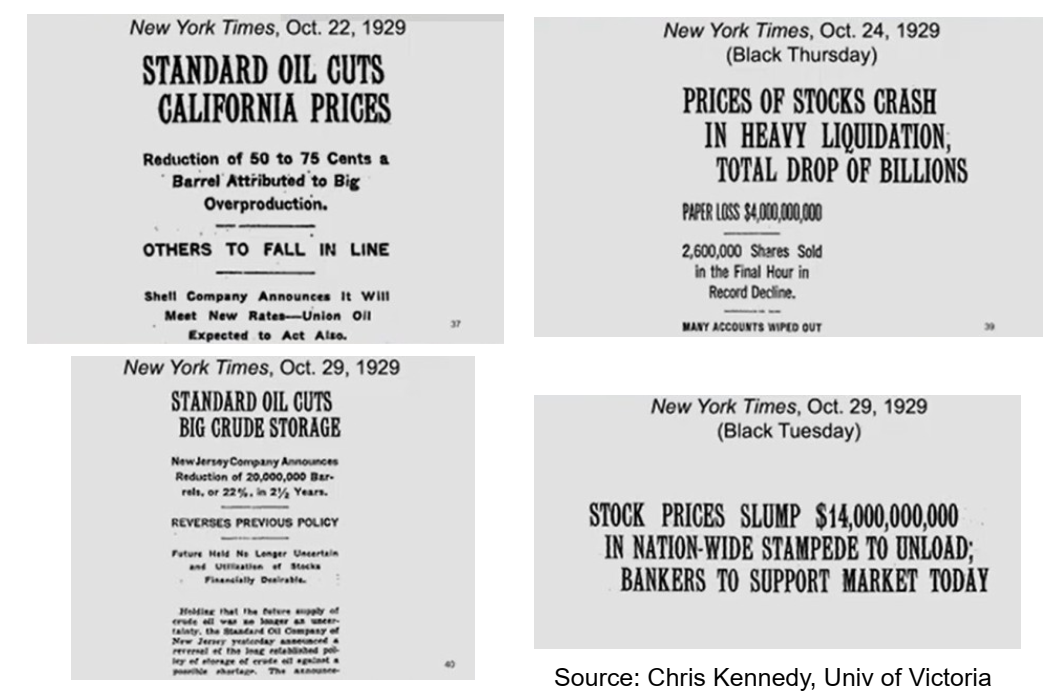
Note that the oil news and the stock collapse reported on October 24 and 29 reflect events on the previous day. October 24 and especially October 29 were worse.
References
Akerlof, George A., and Robert J. Shiller, Animal Spirits: How Human Psychology Drives the Economy, and Why It Matters for Global Capitalism, Princeton: Princeton University Press, 2010.
Akerlof, George A., and Paul M. Romer, “Looting: The Economic Underworld of Bankruptcy for Profit,” Brookings Papers in Economic Analysis, 2:1993, 1-60.
Arnold, Thurman, The Folklore of Capitalism, Beard Books, 2000 [1937].
Bernanke, Ben S., “Irreversibility, Uncertainty, and Cyclical Investment.” Quarterly Journal of Economics 98 (February 1983): 85-106.
Bernanke, Ben S., “The Macroeconomics of the Great Depression: A Comparative Approach” Journal of Money, Credit, and Banking, Vol. 27, No. 1 (February 1995), 1-28.
Black, William K., The Best Way to Rob a Bank is to Own One, Austin: University of Texas Press, 2005.
DeVroey, Michel and Luca Pensieroso, “Real Business Cycle Theory and the Great Depression: The Abandonment of the Abstentionist Viewpoint” ECON Discussion Papers ; 2005/42 (2005) http:// hdl.handle.net/2078.1/5735
Eichengreen, Barry, Globalizing Capital: A History of the International Monetary System, Princeton: Princeton University Press, 2019.
Fenberg, Stephen, Unprecedented Power: Jesse Jones, Capitalism and the Common Good, College Station, Texas A&M Press, 2011.
Ferguson, Thomas and James K. Galbraith, “The American Wage Structure, 1920-1946,” Research in Economic History, Vol. 19, 205-257, 1999.
Friedman, Milton and Anna Schwartz, A Monetary History of the United States, 1867 – 1960. Princeton: Princeton University Press, 1963.
Historical Statistics of the United States, Millennial Edition, Volume 4: Economic Sectors.
Galbraith, James K. and Jing Chen, Entropy Economics: The Living Basis of Value and Production, Chicago, 2025.
Galbraith, John Kenneth, The Great Crash, 1929, Cambridge: Houghton Mifflin, 1955.
Kennedy, Christopher A., “Oil discovery, energy transition, and the decline in wholesale prices during the Great Depression”. J Ind Ecol. 2025;29(1):233-245. doi: 10.1111/jiec.13602. Epub 2024 Dec 29. PMID: 42017193; PMCID: PMC13092543.
Kennedy, Christopher A., “How an Energy Transition Underlay the Great Depression,” Levy Institute Working Paper No. 1121, July 2, 2026.
Keynes, John Maynard, “The Slump of 1930,” in Essays in Persuasion, London: MacMillan,1933.
Kindleberger, Charles, The World in Depression, 1929-1939, University of California Press, 1973.
Lewis, Michael, The Big Short: Inside the Doomsday Machine. New York: WW Norton, 2011.
Lucas, Robert, “Review of Milton Friedman and Anna J. Schwartz, A Monetary History of the United States, 1867-1960” in Journal of Monetary Economics, Vol. 34, 5-16. Quoted in De Vroey and Pensieroso, supra.
Mandelbrot, Benoit B., “A Multifractal Walk down Wall Street,” Scientific American, February 1999, 70-73.
Minsky, Hyman, Stabilizing an Unstable Economy, New York: McGraw-Hill, 2008.
Morris, Charles, A Rabble of Dead Money, PublicAffairs, 2017.
Romer, Christina, “The Great Crash and the Onset of the Great Depression,” Cambridge: NBER Working Paper 2639, 1988.
Ross Sorkin, Andrew, 1929: Inside the Greatest Crash in Wall Street History, and How It Shattered a Nation. Viking, 2025.
Rostow, Walt W. The Process of Economic Growth, New York, 1962, 302-303.
Schlesinger, Arthur M., The Coming of the New Deal, London: Heineman, 1960.
Schumpeter, Joseph A. Capitalism, Socialism and Democracy, Harper Perennial Modern Classics, 2008 [1943].
Selgin, George. False Dawn: The New Deal and the Promise of Recovery, 1933–1947. University of Chicago Press, 2025.
Summers, Lawrence, “Some Skeptical Observations on the Real Business Cycle Theory”, Federal Reserve Bank of Minneapolis Quarterly Review, 1986, vol. 10, pg. 23–27. Cited in De Vroey and Pensieroso, supra.
Temin, Peter, Did Monetary Forces Cause the Great Depression? New York: Norton, 1976.
Veblen, Thorstein, The Instinct of Workmanship and the State of the Industrial Arts, New York: B.W. Heubsch, 1922.
Wanniski, Jude, The Way the World Works, Regnery, 1978.
前回の大事故は次の事故について何を語ることができるでしょうか?石油、AI、そして技術革命の危険性
ブラック・チューズデーから97年、投資家は同じ間違いを犯しているのでしょうか?
1929年の大恐慌とそれに続く大恐慌から100年が経った現在でも、これらの出来事について満足できる、かつ合意された説明が見出されていないという奇妙な事実です。
私の父の本は、1954年夏にダートマスで新聞記事を主に元に執筆された、クラッシュに焦点を当てた最初の歴史でした。それまで、恐慌、ニューディール、そして戦争の混乱は学術的、一般大衆的、政治的関心を集めており、1929年10月のドラマは記憶の中で薄れ始めていた。The Great Crash 1929は、それがそうないと保証しました。
『Crash』を前面に据えることで、父は金銭的愚行の素晴らしい物語を語ることができ、その金銭的愚行は奇行に満ち、ほとんど無邪気な全米的な欲望に根ざした、実際に働かずに金持ちになりたいという欲求に根ざしています。それは多くの先行要因と多くの再発を持つモチーフです。熱狂、傲慢、そしてリアップの要素は、正当であれそうでないであれ、金融市場をより大きな人間の経験と結びつけます。そして、この人間味あるアプローチは、以降テーマに取り組んだ他の人々にも採用されており、特にチャールズ・モリスとアンドリュー・ロス・ソーキンが思い浮かびます。
クラッシュを中心に理論が構築されている程度において、それはハイマン・ミンスキーの「金融不安定性仮説」である。この物語は、負債の構造における相転移(ヘッジ、投機的、ポンジ)についてであり、温度上昇に伴い水が氷から液体、そして蒸気へと移行する過程に似ています。安定は不安定さを生む、とミンスキーは書いた。そして、クラッシュのようなエピソードは資本主義に固有である;ダイナミズムと脆弱性は同じ獣の切り離せない部分である。ベノワ・マンデルブロの「マルチフラクタルジェネレーター」の金融価格は同じメッセージを伝えます。システムは一般的に利益をもたらしますが、同じプロセスは、全く予測不可能で警告もなく、すべてを奪い去る巨大な打撃を与えることができます。
第二の関連概念は、非常に不便であり、したがって学術的に軽視されているものの、ウィリアム・Kです。ブラックの「コントロール・フラッド」は、(他に何と)定義されていますか?支配者による詐欺。コントロール詐欺は、意図的な崩壊、あるいはジョージ・アケルロフとポール・ローマーが述べたように、利益のための破産である。典型的な事例は、1980年代から1990年代にかけての貯蓄とローンの混乱であり、規制緩和が主要機関の犯罪的乗っ取りを助長した時期であり、特にカリフォルニア州とテキサス州において、これらの機関は政治的友人によって長期間保護されていました。注意深く見守っている方々にとって、支配詐欺の検出は、2007〜2009年の大金融危機に至るまでの状況など、特定の状況において崩壊を予測可能にすることがあります。これが、マイケル・ルイスが記録したビッグ・ショートが起こり得る理由です。
これらの物語とそれに付随する理論は、金融プロセスと金融市場に注目しています。このようなプロセスや市場は、物事の本質の構築において、独自の生命を有しています。それらは「実体経済」と呼ばれるものから切り離されており、特定の法制度や文化、技術を参照せずに分析できるようです。このアプローチは金融不安定性を普遍化し、あるエピソードがほぼ他と比較可能になるようにし、17世紀後半のオランダのチューリップ熱に遡り、人工知能とデータセンターが普及した現在の時代へと進んだ。
金融の混乱の比較可能性は、バブルという物理的比喩によって捉えられていますが、説明はされていません。その比喩は、単一のイメージにおいて、安定した膨張と急激な崩壊の両方を伝え、未知の時点でのある種の結末を示しています。しかし、その比喩は思考に取って代わり、どちらにも因果関係の説明がないという事実を覆い隠しています。そして、バブルと他のものとを区別する方法は存在せず、別の欺瞞的な比喩である「ソフトランディング」に合います。
クラッシュと不況
それでは、いわゆる「実体経済」と金融不安定性の関係は何ですか?特に、大恐慌は大恐慌とどのように関係していましたか?
大恐慌は1929年の大恐慌の中心的な焦点ではなく、父は相互に関連する5つの原因について概観的な調査しか提供しませんでした。これらは、所得分配の不均衡、企業構造の不全(レバレッジが過剰)、銀行の構造の不調(預金保険がないことの意味)、「疑わしい外国収支」(債務不履行への脆弱性)、そして「経済的知性の低さ」、すなわちケインズ以前の均衡予算へのコミットメントでした。含意として、これらの問題が1920年代に対処されていたなら、恐慌は起こらなかった可能性がある、と仮定される。しかし、その場合、1920年代は1920年代ではなかったでしょう。私はそのような見方に過度に傾くことはありませんし、父も同様にそうは思いません。事実として、彼はこの短く焦点を絞った本でうつ病について説明する必要はないと感じており、私の知る限りでは、他の場所では説明していませんでした。
私の父は、クラッシュが大恐慌の開始に役立ったと信じていました。そうでなければ、彼は本を書かなかったかもしれません。しかし、この点については、主流の経済学者は意見が一致していません。現代経済学の支配的な学派にとって、クラッシュは不況を「caused」したとは不況であり、さらには影響を与えたとは不可能だった。この学校では、市場経済は本質的に安定しているか自己安定的であり、金融市場は根本的なドリフトの指標にすぎません。「実体経済」に影響を与えるためには、外部から実体経済に何らかのものが及ぶ必要があります。何らかの「ショック」が必要です。一部の経済学者は、暴落が起こる前から不況が進行していたと主張しており、そのため株式市場はその後の暗い年月において原因ではなく偶発的な効果となるとしています。
おしゃべりな経済学者の簡潔な調査
クラッシュと不況の謎は、1世紀以上にわたり、相互に矛盾する多くの見解を生み出してきました[1]
ジョン・メイナード・ケインズは、1930年に執筆し、「金融」と「実在」の区別そのものは根拠がなく、誤解を招くものであり、論点から外れていると主張した。株式市場の崩壊は、利益期待の崩壊であり、事業資本投資の社会心理的基盤に根本的な変化をもたらすものでした。利益の期待がないままで、事業投資も崩壊し、投資の流れがなければ、生産に対する総需要も同様に崩壊した。したがって、ケインズは、利用可能な手段、特に公共支出や公共事業によって、実効的総需要を増加させることが解決策であると主張できた。これがケインズ主義の本質でした:治癒をもたらすために原因を逆転させる必要はありません。しかし、ケインズは利益期待の崩壊について具体的な理由を挙げず、晩年の支持者(特にジョージ・アカーロフとロバート・シラー)は手を挙げて彼の「動物の霊」[2]という言及を繰り返しました。しかし、資本主義は本当に、全く根拠のない大規模な崩壊の対象となっているのでしょうか?もしそうであるなら、なぜ大クラッシュはそれほど稀で、実に唯一無二の出来事だったのでしょうか?
ミルトン・フリードマンとアンナ・シュワルツは、1960年代初頭に執筆し、連邦準備制度が通貨供給の崩壊を防げなかったこと、そしてそれに付随して通貨供給の崩壊を不況の原因として非難した。この興味深い議論は、景気後退と崩壊を切り離し、(確固たる根拠なく)貨幣供給の崩壊を防ぐ権限はそもそも連邦準備制度にあると想定した。しかし、それはフリードマンとシュワルツが以前に信じた民間経済の自然な安定性に基づいており、したがって、起こり得るすべての失敗に対する政府の責任という構造から生じた。
チャールズ・キンドルバーガーは、1973年に執筆し、ポンドの覇権からの移行過程にある国際通貨体制の弱さを強調しましたが、まだドルの覇権には至っていません。バリー・アイシェングリーンは、この伝統を継承し、主に発展させています。
ピーター・テミンは1976年に執筆し、当時学術経済学者の間で支配的であったフリードマンとシュワルツを批判しようとした。テミンはケインズに倣って需要を強調しましたが、需要の減少を消費機能のシフトに根付加したという修正を加えました。そのシフトは見かけ上は外生的であり、説明しにくいものです。1920年代後半にアメリカの家庭で、以前に見られたり、その後再現されたりしたようなことが起きたのでしょうか?
1970年代中頃に執筆したジュード・ワニスキーは、スムート=ホーリー関税を非難しましたが、この議論は『The Great Crash 1929』でやや支持されており、同関税がペルーの債務不履行を助長し、これらの融資を行った銀行への信頼を損なうことになったと指摘しています。しかし、これはワニスキーの仕組みではありませんでした。彼にとって根本的な罪は、自由市場と自由貿易に対する冒涜でした。
ベン・バーナンキは、1983年に執筆し、「不確実性」の上昇を非難し、この議論は1988年にクリスティーナ・ローマーによって概ね要約されました。彼らの主張は不況とクラッシュを結びつけましたが、クラッシュは外部ショックであるか、金融市場に固有のものとして説明されていませんでした。バーナンキは投資支出に注力し、ローマーは耐久消費財の購入という側面を加えました。彼女は「株式市場の暴落が消費者と生産者に将来の収入の流れについて不確かさをもたらした」と書いています。(強調は追加)
2000年代にさかのぼる比較的最近の研究のいくつか、すなわちニューディール政策に不況を帰すもの、特に国家産業回復法の価格操作の取り組みや農業調整局の作物削減プログラムについて、コメントする必要はありません。この作品は、1929年、1930年、1931年の出来事の責任を、1933年に制定された政策に都合よく委ねており、合理的な先見の明の真の偉業です。実際、ニューディールが完全に逆効果であり、本来起こっていたはずの自然回復を妨げていると主張することが、やや流行しています[3]。
一方で、“real business cycle”の従者にとって、景気後退は異常ではなく、正常なものであり、したがってそれが見られる懸念を正当化する出来事ではありませんでした。サイクルは技術の流れと流れのおかげで起こります。この事例に適用された場合、教義は「総要素生産性」が低下し、残りはそれに続くと規定しています。しかし、全要素生産性は曖昧な概念であり、この考えに特定の資産や特定の技術が関連しているようには見受けられません。これにより、ロバート・ルーカスが1994年に「新しい古典派」と称し、次のように述べた。「大規模で多様化した経済において、どのような技術的または心理的出来事がこのような行動を引き起こし得るのか?」どうしてそのような出来事は当時目立たず、後に見えないままでいられたのでしょうか?非常に妥当な質問です。
要するに、なんて混乱だ!いくつかは明らかにナンセンスですが、上記のリストは完全に間違っているわけではありません。それは、近接原因、要因、偽相関、そして観測不可能な要素に基づく空虚で反証不可能な主張を含みます。例えば、ラリー・サマーズが1986年に述べた「What happened was a failure of the exchange mechanism.」というような。存在しないのは、株式市場が崩壊した理由と、資本投資が崩壊した理由、銀行が崩壊した理由、そして需要と最終的に生産が崩壊した理由の両方を説明できる、明白な出来事です。恐竜の絶滅、ローマの崩壊、そしてマヤ文明の崩壊について、我々の経済学者が示した前世紀の決定的な経済出来事よりも、我々の見解の方がより優れているようです。
しかし、もしそれが起こる出来事だったと仮定した場合はどうでしょうか?仮に、私たちがそれを見逃したのは、そのような出来事を災害に変える可能性のある根本的な経済プロセスを理解できなかったからでしょうか?
エントロピー経済学の基礎
すべての生命は資源を必要とし、その資源は環境から抽出され、十分な余剰が確保された状態で、働き、発展し、成長し、繁殖できるようにしなければなりません。そして、これはあらゆる機械システムやあらゆる経済に対して、同じことが当てはまります。資源へのアクセスにはエネルギーが必要であり、そのエネルギーはまず太陽光や、木材、石炭、石油、天然ガスなどの蓄積された形態、さらに特定の非常に重い原子の核からも得られます。エネルギーにたなるには、計画に従って構築されたツールが必要であり、技術が進歩するにつれて複雑さが増大します。しかし、複雑さは両刃の剣です。それは資源の利用効率をますます高め、結果として生産水準の向上と人間生活の向上を可能にしますが、システム全体に脆弱性をもたらします。システムが構築されれば、設計された条件が満たされている限り、特定の予測可能で事前に定められた方法で機能します。しかし、それらの条件は変わる可能性があります。単純なシステムは堅牢であり、複雑なシステムは重大な故障や災害が起きやすいです。
経済的価値は、必要であるものや望ましいものがしばしば希少であるために生じます。そして、これは特に、新たに創造された、想像された、または新しく見えるように包装された商品やサービスに当てはまります。イノベーションは定義上、最近のものであり、定義上、単一の創始者を有しています。イノベーションは、通常、新たなレベルの複雑性を導入し、既存の技術形態の設計や再結合といったその他の改良によって達成されます。たとえ短いウィンドウであっても、模倣が少ない期間において、創始者は市場と独占的な支配力を享受し、イノベーションの希少性に伴う経済的価値を高めます。これは、運が築く瞬間です。そして、経済生活は、すでに存在するものよりも新しく、より良く、またはより安価に作られたものの同様に優れたものを生み出すことから生じる、幸運の探求に支配されています。
これらは、ジン・チェンと私が2025年に出版された小さな本で「エントロピー経済学」と呼んでいる基本的な要素です。私たちの目標は(そして現在)、経済学を、現在、他のすべての人間の探求分野で広く浸透している熱力学第二法則(エントロピーの法則)と整合させることであり、これは自然の最も根本的な法則です。私たちは、これが実際に大恐慌と大恐慌の背後に、急激な技術的出来事が存在したことを理解する鍵であると考えています。
主流(新古典派)経済学において、技術変化は概ね連続的なプロセスであり、加速と減速の段階があります。それは事態をさらに悪化させることはできません。それが、主流の経済学者が執拗なテクノ愛好家である理由です――彼らは、不平等や環境破壊、そして労働者層が資本家階級に対して抱く固有の疑念に直面した際、資本主義の活力をその主要な正当化として見なしています。ジョセフ・シュンペーターは、保守的でありながら確実に主流ではない1930年代の観察者であり、はるかに冷徹で明晰な見解を持ち、その見解は「創造的破壊」という表現で要約されました。シュンペーターの洞察は、新しい技術が古い文明や生活様式を破壊し、(彼は)生存者にとっての改善をもたらすが、以前のシステムや方法に投資した者にとっては重大な代償を伴うわけではない、というものでした。実際、この理由から、農民や中世のギルドは本質的に技術的に保守的であり、彼らは自分たちが持っていたものを保持し、後に他者に得られる大きな利益を気にしなかったのです。しかし、私の知る限り、シュンペーターはこの物語の重要な瞬間を埋める新しい技術を具体的に特定していません。
我々は、今回の事例における先発事象は、テキサス州、オクラホマ州、カリフォルニア州における膨大な石油埋蔵量の発見の発表であると考えております。
石油とアメリカエネルギー革命
産業革命は、19世紀初頭にイギリスで始まり、石炭を基盤とした革命であり、蒸気で動く機械への石炭の応用を基礎としたものです。それの最初の応用はポンプであり、地中から石炭を抽出する効率を向上させ、コストを削減しました。それはそこから金属加工、特に鉄鋼へと広がり、鉄道を経て、そしてその後海上艦隊を経て、そして(さらに後に)電化へと、鋼の輸送への応用へと広がった。イギリスの電力は石炭火力であり、マーガレット・サッチャーと北海石油の時代まで良好に存続していました。
アメリカ合衆国はイギリスの路線をたどりましたが、木材の備蓄がより多く、かなりの水力も有しており、アパラチアで石炭を採掘して、19世紀半ばまでに大陸全体に及ぶ鉄道システムに電力を供給しました。20世紀初頭の数十年になると、鉄道は最大(そして悪名高いほど捕食的)な米国産業となり、その派生需要はミネソタ州の鉄鉱山と五大湖の製鉄所を支えていました。1913年に連邦準備制度が設立された際、その地域銀行のうち2つはミズーリ州に所在していました(St.ルイとカンザスシティ)は、米国の中心部における鉄道網が農業と産業の両方にとって中心的であることを示しています。
しかし、世紀の第2十年になると、新たなエネルギー源が開発されていました。トラックは油で動力を得ており、飛行機も同様に、どちらも第一次世界大戦で頻繁に使用され、トールスタイン・ヴェブレンが指摘したように、発明は必然の母である。1919年、ドワイト・アイゼンハワー大佐がモーターコンボイで大陸横断に出発し、鉄道で走行できる通過に60日を要し、その時点で1週間未満で完了した。大陸横断高速道路(リンカーン・ハイウェイ)が作られましたが、1930年に父がクリーブランドからバークレーへ車で向かった際、その道路はネブラスカ州リンカーンからカリフォルニア線まで未舗装でした。
1920年代は自動車産業にとって好景気の年であり、1929年までに生産台数は5,358,000台に上昇しました。この数字は『The Great Crash 1929』で報告されており、1953年の豪華な年における5,700,000台の新車登録と非常に妥当な評価されています。それはまた、トラクターが盛況で、アメリカの農業を変革していた時期でもありました。19世紀後半のアメリカの耕作可能な土地の約3分の1は飼料に利用されており、特に耕作地の前でほとんどの作業を行う馬の飼育が大量に利用されていました。トラクターはその土地を解放し、食料作物用と家畜用の土地を一部にしました。彼らはまた、より速く作業し、より少ない人数で作業しました。農業生産性は急上し、米国の食料生産能力や輸出さえも上回った。需要の大幅な中断は、うまく終わない可能性が高いです。
しかし、これらが必ずしも終わる必要はなく、特に1929年10月の数日間にわたる圧倒的な衝突で終わる必要はありませんでした。石油は入手可能でしたが、比較的不足しており、そのため高価でした。石炭、蒸気、鉄鋼、そして鉄道は、大規模で高度に発達した複雑なインフラの効率性を享受しており、その基盤にはすでにアメリカの都市や工場が建設されていた。確かに都市鉄道システムもあり、ニューヨーク、ボストン、シカゴに現在も存続している地下鉄や、ロサンゼルス、サンフランシスコ、ワシントンDCなど、比較的新しく成長している都市が拡大できるようにした路面電車も存在していました。これらは石炭で電力供給された電気ケーブルで走っていました。この技術的パラダイムが存続すると期待できる十分な理由がありましたが、突然それがなくなったのです。
謎の鍵は、ブリティッシュコロンビア州ビクトリア大学のクリストファー・ケネディによって見出されました――気候や類似の課題に関する研究実績が豊富な産業・生態学経済学者です[4]それは新しい発明にあるのではなく、石油の評価を変え、したがって他の燃料で走っているすべてのものの将来的な収益性を変える発見にあります。これは、1929年の後半に、テキサス州、オクラホマ州、カリフォルニア州における広大な新埋蔵量の発見です[5]
具体的には、ケネディが発見したように、1929年10月22日、ニューヨーク・タイムズはカリフォルニア州スタンダード・オイルが原油価格を1バレルあたり50〜75セント、約50%引き下げると発表しました。これは「大規模な過剰生産」のためであり、他の主要企業もそれに続くと予想されています。23日の株式損失は40億ドルと報告されました。翌日はブラック・サーズデーでした。「歴史が、たとえばこのテーマに関して、1929年のパニックと同一視する日の最初の日です[6]」その後、10月29日、28日に140億ドルの損失(「また別の恐ろしい日」)とともに、The Timesはスタンダード・オイル・オブ・ニュージャージーが石油の保管を削減すると報じました。その石油は、販売できる量をはるかに超えるほど、すぐに入手可能な量があるからです。同じ日にブラック・チューズデーがやって来ました。「ニューヨーク株式市場の歴史上最も壊滅的な日であり、市場の歴史の中で最も壊滅的な日であった可能性があります。」1929年の大事故が起こっていました。
しかし、これほど極めて有利な開発、すなわち実質的に無制限で高品質なエネルギー源の発見が、考え得るすべての産業・農業・家庭用、ましてや軍事用途に至っては、金融市場のパニックと実際の活動の崩壊をもたらすとは、いかにしてでしょうか?これは、技術変化に関する主流の見解が説明できるものではありません!全ての権利に基づき、1929年にアメリカ西部全体で見つかったものは、経済ブーム、すなわち生産性・生産・繁栄の爆発へと導くべきであった。しかし、それはしませんでした。あるいは、より正確に言えば、それはすぐにはそうせず、直近や中期的な将来にわたってそれを約束したわけではありません。
むしろ。問題は、株式市場が一般的な経済ではなく、既存の経済システムの将来の期待収益性を捉えていることです。1929年、そのシステムは鉄道、鉄鋼、石炭、蒸気を中心とし、南北戦争後に北米大陸を横断する大鉄道回廊の周辺に建設された輸送・販売システムを利用するために建設された工場に重点が置かれていました。突然、その既存のシステムの将来は単に疑わしかっただけではなくなった。それは、石炭が衰退し、石油がそれに取って代わり、突然かつ確実な終焉に直面した。利益の期待がなければ投資は存在せず、投資がなければ総需要は減少します――それはケインズが述べたような一連の流れです。
なぜレールを単に油に変換しないのですか?壁に書かれたのは、石炭燃料機関車だけでなく、鉄道経済全体に関するものでした。そして、道路や飛行場、製油所やパイプライン、ガソリンスタンド、燃料貯蔵所がない自動車、トラック、航空機に基づく新しい経済を構築することはできません。これらは、まだ規模で存在しませんでした。そして1929年には、彼らが近い将来に存在することは極めて明らかではありませんでした。実際に、誰がそれらを提供するのでしょうか?道路に通行料を支払わせることは(現在でも)難しいです。市場や活動が減少するにつれて、税収も減少し、したがって連邦レベル以下の政府単位が利用できる資源も同様に減少しました。連邦政府が介入することもなく、運営者が税金から徴収できる収入に制約されていると自信している限りです。
崩壊から不況への道は、銀行システムの危機を通ります。銀行は二つの非常に大規模な資産を保有していました。一つは農地の抵当権と作物の貸付でした。これらは、農家が増加する生産を利益で排出できなかったため、失敗します。続く差し押さえにより農地が市場に出され、残された人々の担保が削られ、彼らの破滅がさらに深まることになる。そして、銀行が保有するもう一つの大規模な資産は、鉄道の負債でした。これらも尊重できませんでした。産業ローンや農業ローンのいずれも回収できなかった銀行はリスクにさらされており、その預金者はこの事実を警告された時点で、存続しないでしょう。ランは銀行システムの大規模な縮小を確実にした。銀行の破綻は1929年から1930年にかけて倍増し、1931年に再び増加し、1933年の初めの数か月でピークに達しました。その後、ルーズベルト大統領は就任し、行動を起こし、危機は緩和されました。
ニューディールは、当時の文献や大多数の歴史家[7]において、主に百日(百日)に始まる立法の急速な進展によって記憶されています:緊急銀行法、農業調整、国家産業回復法、公共事業・事業進捗管理局、民間保全隊、テネシーバレー・オーソリティ。これらは第二次ニューディールでワグナー法と社会保障に続き、そして30年の後、リンドン・ジョンソンの『グレート・ソサエティ』ではメディケアとメディケイドが続きました。しかし、そこにはもっと多くのことがあります。
再建金融公社は、ハーバート・フーバーの下で設立され、限定的な目的を持っていました。ルーズベルトはそれらを大幅に拡大し、ジェシー・Hに莫大な権力を投資しました。テキサス州ヒューストン出身のジョーンズは、石油の台頭に親しんだ人物です[8]ジョーンズは連邦準備制度の地域部門にRFCを設置し、石油に関連するインフラ投資の波に資金提供を進めました:主にアスファルトで舗装された60万マイルの舗装道路、1,000の飛行場、ベイブリッジ、トリボロウ橋、リンカーントンネルなど[9]、鉄道用のディーゼル電気機関車[10]や海軍向けの石油燃料空母を含む。1930年代末までにインフラは整備され、技術的な不確実性は解消され、1950年代から1970年代にかけて(良し悪しにかかわらず)繁栄する高速道路と郊外経済への道が開かれました。
エネルギーエントロピー的な解釈による大恐慌、恐慌、そしてニューディールは、他のいかなる取り組みも実現できなかったことを実現し、三つの事象を一貫した全体に統合し、金融経済を実体経済と結びつけます。それはケインズの核心的洞察――利益期待の崩壊が資本投資の崩壊につながる――と一致していますが、純粋に心理的な「動物精神」の崩壊という見かけ上の偶然性は見なくものではありません。それは、民間経済が自力で回復できなかった理由を示し、フリードマンとシュワルツの貨幣主義的見解を否定し、同様に、民間市場の自己安定的な特性と成長統計への回帰を信じる今日のリバタリアンをも反証しています。それは、ニューディールの技術的貢献が今後の道筋を決定的に導いた正確な方法を示しています――その結果として生まれた石油ベースの経済を好むかどうかは、全く別の問題です。そして、それは1970年代の危機に光を当て、石油が再び突然不足し高価になったこと、そして2009年以降の回復についても光を当てています。その回復は、フラッキングにより米国のエネルギー経済が当面回復しました。
エントロピー経済学とAIブーム:大暴落からの教訓
大暴落の100周年が近づく中、米国は再びブームに巻き込まれ、現在株式市場を支配する「素晴らしい七社」企業の人工知能投資によって支えられています。父が1920年代に特定した多くの条件は容易に認識できる:所得分配の不均衡、企業構造の不均衡(レバレッジと集中した権力)、不全(極めて集中した)銀行システム、疑わしい対外収支――そして再び「経済的知性の乏しい状態」。父の灯りにより、私たちは、クラッシュの再来と続く不況の再来に向けて、私たちはすべて整っているはずです。
それでは、誘因についてはどうでしょうか?特に、エネルギーについてはどうでしょうか、そして人工知能とデータセンターの具体的な特性や特性についてはどうでしょうか?
現在執筆中、エネルギー経済は地質的、地政学的、技術的な未知数に満ちています。米国では、石油と天然ガスは2009年以降豊富にあり、予想外です。フラッキングの登場とペルミアン盆地の高い生産性のおかげで、アメリカ合衆国は再び世界最大の石油生産国となり、天然ガスの主要な輸出国となりました。これがどれくらい続くかは最初の未知数です:井戸数は減少しており、生産は2025年にピークに達した可能性があります。価格の将来は第二の未知であり、特に新たな探査やより集中的な掘削を促すために必要な水準を超えて維持されるかどうかです。このような価格が国内の他のすべての経済活動に与える影響は、三つ目の未知数ですが、米国経済は、たとえ大規模であっても、低い石油価格で運営されていることは明らかです。
今後見当たらないのは、石油・ガス・石炭を経済史のゴミ箱に残すと、非常に称賛されている「エネルギー転換」です。風力と太陽光からの大幅な増加が達成されたことは事実であり、原子力発電の控えめな復活が始まっている可能性があります。しかし、現在150年以上の歴史を持つジェヴォンズ法は、新たにオンラインにされるエネルギー源が1回ごとに新たな利用例が現れ、結果としてすべてのエネルギー形態がますます大量に使用されると述べています。ジェヴォンズ法は廃止されておらず、今日の世界はかつてないほど多くの石炭、石油、ガス、水力、原子力を使用しています[11]。原子時代の黎明期以来、定期的に新しいエネルギー形態が化石燃料経済を弱体化させる可能性があると大々に宣伝されてきましたが、これは1929年以降に石油が石炭の背を壊したのと同様です。近い将来にそのようなことの明確な兆候はありません。
人工知能は、まず第一に、既存エネルギーを貪欲に利用し、電力インフラ(発電所、送電線、変圧器など)における他のすべての利用と競合する存在として、登場します。したがって、これは、信頼できる安価な電力に合わせ、かつそれに依存して建てられた住宅に住むアメリカの家庭の核心を狙ったコストインフレのベクトルです。もし、予想通り、データセンターのブームが電力供給の増加に先を走るのであれば、需要に応える唯一の方法は、他のすべての利用者に対して電力料金を引き上げることです。これは、電力消費を容易に調整できないアメリカの世帯にとって、不平等を深め、生活の不安定さを増大させます。最も簡単に言えば、AIは生命のジュースに対する競争相手として現れます。
第二のリスクは、AIブームが、根本的な過剰投資と商品(あるいはサービス)の過剰生産により終わることです。経済的利用が不十分であるこの結果は、2000年のインターネット崩壊に似ており、NASDAQを下落させ、多くの若くかつて有望とされたスタートアップを壁まで追い込みました。しかし、インターネットは存続し、付随するインフラは当初は過剰に建設されていましたが、最終的には経済生活の構造に吸収されました。2000年の不況は大恐慌ではありませんでした。
人工知能が発展し続ける中で、何に取って代わるのかと問わざるを得ません。答えは遠くありません:人工知能は本物の安価な代替手段です。人間の知性は、時間をかけて、大きな代償を払ってゆっくりと育まれるものです。それは、固定資本への大規模な投資と、代替利用が限られる(学校、大学、図書館、研修施設など)を必要とします。新自由主義時代において、これらの制度を維持する主要な根拠は、受刑者の将来の収入への貢献と、国の「競争力」と呼ばれるものを維持する上での役割であった。どちらもAIによって弱体化しています。おそらく、学校や大学は、日常的な精神的労働の圧力から解放された社会において、自己のために需要が高まる、贅沢な消費財という旧来の役割に戻ることができるかもしれません。可能性はありますが、可能性は低いです。むしろ、これらの機関が縮小し、多くが消滅する可能性が高い結果となります。
別の可能性があります。それは、1929年のシナリオに近く、そしてそれが大恐慌にもたらす結果に近い可能性があります。たとえば、何かが突然、AIセクター全体の予想収益性を下し、データセンターへの大規模投資が取り残された資産として浮上したとしたら、ヤングスタウンの製鉄所や、(さらに以前の)ロウェルとローレンスの繊維工場のように?さらに、それが米国外から生じたものであり、新たなパラダイムに沿った後の成長と繁栄の時代を予見しないと仮定すると、
その可能性は存在します。すでにそれの兆候があります。もちろん、彼らは中華人民共和国から来ています。もし起こり得ること、そして起こり得ることとして、AI競争において中国が米国を上回ることになると、確固たるもの(そして、何も堅実でないもの)はすべて塵になるでしょう。ご注意ください。
原油価格の崩壊と株式の崩壊、1929年
ご注意ください、10月24日と29日に報告された石油ニュースおよび株価の急落は、前日の出来事を反映しています。10月24日、特に10月29日はより悪かったです。
参考文献
Akerlof, George A., and Robert J.シラー, 『アニマル・スピリッツ:人間心理学が経済を駆動する方法、そしてグローバル資本主義にとってなぜ重要か』, プリンストン: プリンストン大学出版, 2010年.
Akerlof, George A., and Paul M.Romer, 「略奪:利益目的の破産という経済的闇」, Brookings Papers in Economic Analysis, 2:1993, 1-60.
Arnold, Thurman, 『資本主義の民俗学』, Beard Books, 2000 [1937]
バーンケ, ベン・S., 「不可逆性、不確実性、そして循環的投資」Quarterly Journal of Economics 98(1983年2月): 85-106.
バーナンケ, ベン・S., 「大恐慌のマクロ経済学:比較的アプローチ」 Journal of Money, Credit, and Banking, Vol.27、番号1(1995年2月)、1-28。
ブラック, ウィリアム K., 『銀行強盗の最善の方法は所有すること』, オースティン: テキサス大学出版, 2005.
DeVroey, Michel と Luca Pensieroso, 「実体的景気循環理論と大恐慌:棄権的観点の放棄」 ECON ディスカッションペーパー ; 2005/42 (2005) http:// hdl.handle.net/2078.1/5735
Eichengreen, Barry, 『資本のグローバル化:国際通貨制度の歴史』, プリンストン: プリンストン大学出版, 2019.
フェンバーグ, スティーブン, 『前例のない権力:ジェシー・ジョーンズ, 資本主義と公共の善』, カレッジ・ステーション, テキサスA&Mプレス, 2011.
フェルガソン、トーマス、ジェームズ・K.ガルブレイス, 「アメリカの賃金構造、1920‐1946」, Research in Economic History, Vol.19, 205-257, 1999.
フリードマン、ミルトン、アンナ・シュワルツ、『アメリカ合衆国の貨幣史、1867–1960』プリンストン:プリンストン大学出版局、1963年。
米国歴史統計、ミレニアル版、第4巻:経済部門
Galbraith, James K. と Jing Chen, エントロピー経済学:価値と生産の生きた基盤, シカゴ, 2025.
ガルブレイス, ジョン・ケネス, 『大事故』, 1929, ケンブリッジ: ホートン・ミフリン, 1955.
ケネディ、クリストファー・A.、「石油の発見、エネルギー転換、そして大恐慌期における卸売価格の低下」Jインドエコル。2025;29(1):233-245. doi: 10.1111/jiec.13602.Epub 2024年12月29日PMID: 42017193; PMCID: PMC13092543.
ケネディ、クリストファー・A.、「エネルギー転換が大恐慌の根底にどのようにしたか」、レヴィ研究所ワーキングペーパー No.1121、2026年7月2日。
ケインズ、ジョン・メイナード『1930年の低迷』、In Essays in Persuasion、ロンドン:マクミラン、1933年。
Kindleberger, Charles, 『大恐慌の世界, 1929-1939』, University of California Press, 1973.
ルイス、マイケル、ビッグ・ショート:ドゥームスデイ・マシンの内部ニューヨーク:WW Norton、2011年。
ルーカス、ロバート、「ミルトン・フリードマンとアンナ・Jのレビュー」シュワルツ, 『米国の貨幣史、1867-1960』、Journal of Monetary Economics、Vol.34, 5-16.De Vroey と Pensieroso に引用されています(上記)。
Mandelbrot, Benoit B., 「ウォール街を歩くマルチフラクタルウォーク」, Scientific American, 1999年2月, 70-73.
ミンスキー、ハイマン、不安定な経済の安定化、ニューヨーク:マクグロウ・ヒル、2008年。
Morris, Charles, 『A Rabble of Dead Money』, PublicAffairs, 2017.
Romer, Christina, 「大恐慌と勃発」, Cambridge: NBER Working Paper 2639, 1988.
ロス・ソーキン、アンドリュー、1929年:ウォール街史上最大の墜落の内部と、それが国家を壊した経緯バイキング、2025年。
ロストウ、ウォルト・W.経済成長の過程、ニューヨーク、1962年、302-303.
Schlesinger, Arthur M., 『ニューディールの到来』, ロンドン: Heineman, 1960.
シュンペーター, ジョセフ A.資本主義、社会主義、そして民主主義、Harper Perennial Modern Classics、2008 [1943]
セルジン、ジョージ。偽りの夜明け:ニューディールと回復の約束、1933–1947シカゴ大学出版局、2025年。
サマーズ, ローレンス, 「実体景気循環理論に関するいくつかの懐疑的観察」, ミネアポリス連邦準備銀行季刊レビュー, 1986年, vol. 10, pg.23–27.De Vroey と Pensieroso に引用されています(上記)。
テミン、ピーター、金融の力は大恐慌を引き起こしたのでしょうか?ニューヨーク:ノートン、1976年。
Veblen, Thorstein, 『労働の本能と産業芸術の現状』, ニューヨーク: B.W.Heubsch, 1922.
Wanniski, Jude, 『世界が働く方法』, Regnery, 1978.
- 1.1995年の有名な講義で、ベン・Sは。バーネンケは、恐慌の説明を探すことを「マクロ経済学の聖杯」と呼んだ。バーネンケは「我々はまだいかなる手段でも聖杯を手にしていません...」と述べ、フィールドの調査に先立つ前に述べた。彼の参考文献のタイトルはいずれもエネルギーや、特に石油に言及しておらず、これらの語は講義にも登場しません。代わりに、彼は「貨幣ショック」と国際金本位制の運用に焦点を当てました。バーンキンのアプローチは特徴的です:経済学者は概して、恐慌に関する説明を自分たちがよく知っている領域に焦点を当て、見ていない領域を見ることはできません。
- 2.
- 3.例として、Selgin の『False Dawn』をご覧ください。それは奇妙な議論であり、1936年にFDRが再選に勝ち、メイン州とバーモント州を除外したという事実を説明するのが困難です。
- 4.既存の文献には鉄道の重要性と脆弱性を示す多くの示唆がありますが、それらはクラッシュと不況に関する体系的な説明に同化されていません。例は、ウォルト・ロストウの研究やサーマン・アーノルドの著作、そしてトム・ファーガソンと私自身によるこの期間の相対的賃金変動の要因に関する法医学的研究に見られます。
- 5.推定証明された原油埋蔵量は、1928年の110億バレルから1930年には136億バレルに増加し、1940年までに190億バレルに達しました。彼らは1970年に390億に達し、2001年に224億に減少した。井戸の平均値は1929年に1バレルあたり1.27ドル(すでに1926年の1.88ドルから下落)で、1931年には0.65ドルの安値に下落しました。米国の歴史統計、表 Db 56-59.埋蔵量の現在価値は480億バレルを超えています。
- 6.
- 7.初期でトレンドを牽引する例として、アーサー・Mが挙げられます。シュレジンガー・ジュニアニューディールの到来
- 8.スティーブン・フェンバーグの『Unprecedented Power』をご覧になり、ジョーンズとRFCの詳細な記述をご確認ください。
- 9.マーシャル・アウアーバックに、ニューディールのインフラ記録に関する有益な概要をご評価いただけて、非常に有益です。
- 10.ジョーンズは、鉄道の資金は新しい車両に使用し、債権者や銀行への返済に使用しないことを規定しました。
- 11.クジラ油はこの規則の唯一の例外です。


0 件のコメント:
コメントを投稿